
POWDER METALLURGY (PM/HIP)
POWDER METALLURGY
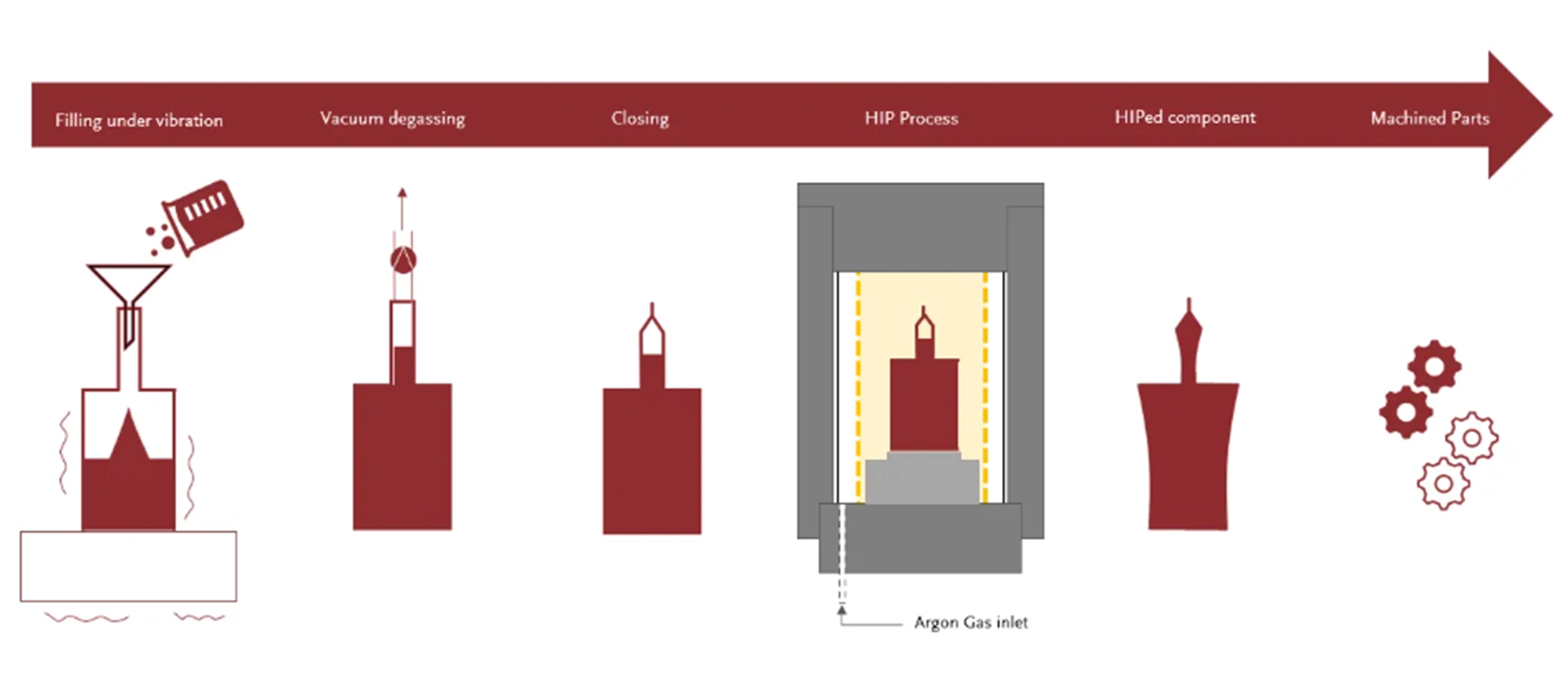
Powder metallurgy (PM/HIP) involves the production of metal powders and their subsequent processing. When combining PM and HIP, a powder is filled into a welded capsule. The capsule is welded as close to the final shape as possible to enable optimal use of the “powder” raw material and to ensure resource-efficient operation. After filling, the capsule is sealed under vacuum and densified into a component using the HIP (Hot Isostatic Pressing) process, which serves for the further processing of the finished part.
When components are treated with the HIP process, internal voids and micro-porosities are eliminated through the simultaneous application of heat and pressure, using a combination of plastic deformation, creep, and diffusion bonding of the material. The powder is thus compacted into a solid material.
PM/HIP PROCESS CHAIN
The PM/HIP process comprises several precisely coordinated steps. This process sequence enables complex components with high dimensional accuracy and density—without conventional casting or milling.
CAPSULE CONSTRUCTION, POWDER, CONSOLIDATION
ECONOMIC EFFICIENCY
MATERIAL, CYCLE TIME, MACHINING EFFORT
Compared to classic machining or casting technology, PM/HIP offers decisive economic advantages. An assessment of your components will show whether PM/HIP is also economically viable for your project.
POWDER METALLURGY FOR
SERIES PRODUCTION
PM/HIP is ideal for series components in safety-critical industries—wherever repeatability, process control, and documented quality are required. The combination of a defined capsule, controlled powder, and a standardized HIP process makes reproducible results the norm.
QUALITY CERTIFICATES & STANDARDS
EXAMPLE APPLICATIONS
All PM/HIP processes at OWL are carried out on the basis of relevant standards:
Typical applications for PM/HIP blanks. We are happy to provide specific reference projects upon request.